
Apostille vs. Attestation: What is the real difference?
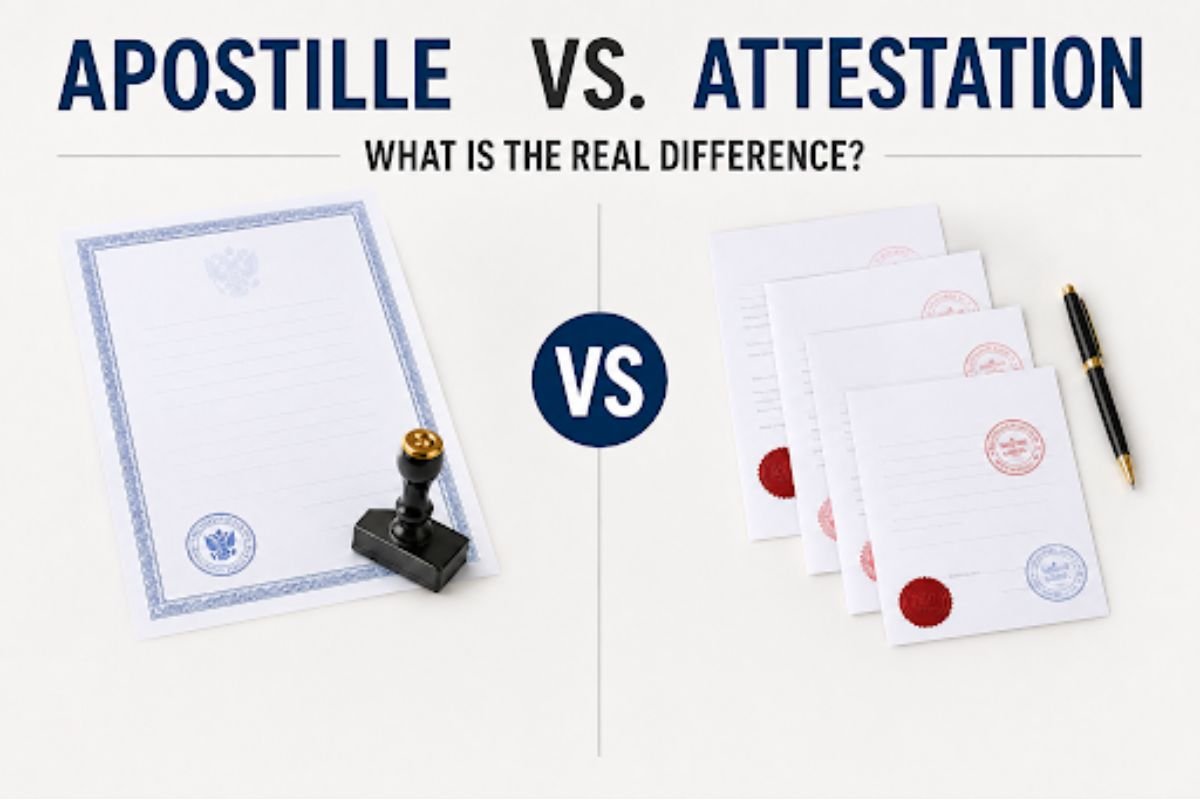
Apostilles can only be used between countries that have agreed to the Hague Convention. One stamp, one authority, done. Your Indian degree only needs an apostille if it is going to a Hague-Convention country, Germany, France, Italy, or dozens of other countries.
The path to getting a certificate is old and long. When the country you are going to is not a party to that convention, like the UAE, Qatar, and most Gulf countries. The paperwork here changes many times: State Home Department, then MEA, then that country’s embassy, sometimes even the final stamp locally.
What Is Apostille?
An apostille is a single certificate that verifies your document is genuine, accepted across all Hague Convention member countries. It’s a quick, one-step process handled by an authorised authority; no embassy visits needed. That’s why more people now turn to apostille services in India, since it saves both time and unnecessary running around.
One stamp. It’s basically an apostille. Any country that signed the 1961 Hague Convention can use a document that has that mark on it; no stop at the embassy is required; every member country takes it as is.
The Ministry of External Affairs is the only office in India that can issue this certificate. Once stamped, it is good in 125+ countries. All over Europe, Japan, the United States, the United Kingdom, and Australia.
Many reasons why people choose it when they can get it:
One certificate, one lordship. Works throughout the entire Hague network automatically. No embassy step. Usually cheaper, usually faster.
How The Apostille Process Goes
Documentation
If the document requires it, a notary will be appointed. Affidavits and power of attorney documents almost always do. Degree certificates usually skip it.
State Verification
The Home Department handles birth and marriage certificates, and the Human Resource Development Department handles education documents. Some states allow filing through Sub-Divisional Magistrates, which can be faster.
MEA Attestation (MEA)
This is the only organization in India that can actually apostille something, and you don’t hand it over to them directly; it goes through a regional office or an approved center.
Translation
This is the only organization in India that can actually apostille something, and you don’t hand it over to them directly; it goes through a regional office or an approved center.
A couple of key things to remember. Kindly give the original, not a copy. If it is not already in English, translate it first. Allow about a week, although this figure depends on your state and how strong the office is.
People often try skipping ahead in this order. Don’t. Each step needs the one before it finished, or you end up redoing the whole thing.
What Is Attestation?
Attestation is the formal process of confirming that a document, statement, or fact is true and accurate. It typically requires a qualified authority, such as a notary, witness, officer, or auditor, to review the document carefully and validate it through a signature, official seal, or formal declaration. This step is important because it establishes trust and accountability, allowing the certified document to be used confidently in legal, financial, administrative, or professional matters. In essence, attestation transforms a simple statement into an official record that others can trust with confidence.
Attestation is basically getting proof that your document is legal before using it abroad. Notaries, government offices, and embassies all play a role. Most people don’t do this alone; they go with embassy attestation services because the rules vary depending on the country and the type of document.
The Attestation Stages
Notarization
Required for affidavits and powers of attorney, optional for most other documents.
State Verification
Based on the document, the Home Department or HRD, or the Sub-Divisional Magistrate in the states where approval is granted.
MEA Attestation
Document verification at the central level before the destination country side begins.
Embassy Attestation
The embassy or consulate of your destination country, which is located here in India, handles its own authentication. Apostille skips this step entirely, and that is the biggest reason why authentication takes longer.
And sometimes, the Ministry of Foreign Affairs (MOFA). Many countries run one final check once the document actually lands there; their own Ministry of Foreign Affairs has to approve it.
Miss a stage, and you restart; that’s just how it works. Anything not in English gets translated before submission. Timeline usually runs two to four weeks, sometimes longer.
Quick Comparison
| Factor | Apostille | Attestation |
|---|---|---|
| Countries | Hague Convention members | Non-Hague (UAE, Saudi Arabia, Qatar, etc.) |
| Steps | One | Several, notary through embassy |
| Authority | One national body | Multiple offices, two countries |
| Timeline | 3–7 working days roughly | 2–4 weeks, sometimes more |
| Cost | Lower | Higher |
| Embassy visit | No | Usually yes |
| Basis | Hague Apostille Convention 1961 | Bilateral agreements |
Which One Applies To You?
Both Attestation and apostille help verify your documents for use abroad, but they work differently. Attestation involves several steps, with a notary, then the state government, and finally the embassy of the destination country checking and certifying the document. This is necessary when the country you are sending to is not part of the Hague Convention. An apostille is much simpler, involving just one authority to attest the document, with no embassy step required. But it only works if both countries are members of the Hague Convention.
If you want to go to European countries like Germany, the US, France, Australia, the UK, Italy, and Spain, you will need an apostille.
If you want to go to Gulf countries like the UAE, Saudi Arabia, Qatar, Oman, Kuwait, Bahrain, etc, you will need an Attestation.
From document collection to final legalization, our UAE Embassy Attestation services handle every step so you no longer have to worry about rejections or delays.
Unsure which bucket your destination falls into? The Hague Conference publishes an official member list online. Two minutes and you’ll know.
Difference Between Hague Convention Countries and Hague Convention Countries
| Point of Difference | Hague Convention Countries | Non-Hague Convention Countries |
|---|---|---|
| Verification Process | Single-step Apostille | Multi-step Attestation |
| Authorities Involved | One designated authority (e.g., MEA) | Notary, State Home Dept/HRD, MEA, and Embassy |
| Time Required | Faster | Takes longer |
| Cost | Relatively affordable | Costlier due to extra stages and embassy fees |
| Example Countries | USA, UK, Germany, France, Australia, Japan | UAE, Qatar, Saudi Arabia, China, Kuwait |
What Documents Are We Even Talking About?
These are primarily the three types of documents that undergo apostille and attestation.
Educational: degree certificates, mark sheets, diplomas, transfer certificates, School leaving certificates, Provisional certificates.
Personal: birth certificates, marriage certificates, death certificates, police clearance, driving license, medical certificates, Affidavits.
Commercial: power of attorney, certificate of incorporation, Memorandum of Understanding (MOUs), invoices, Memorandum of Association (MOA), Articles of Association (AOA).
Which type of document usually decides which state office touches it first. Confirm that early, not halfway through.
The Actual Application Steps
- Fill the form and be clear about whether you want apostille or attestation.
- Keep originals ready with a passport copy and supporting documents.
- Translate first if needed. Submit through the right authority in the right order.
- Check every stamp once it comes back, before you use it anywhere.
Common Mistake People Make
People think it’s the same process, just renamed
This is where things start to go wrong. Somewhere along the way, people got the idea that Attestation was an old version of the apostille – like it naturally evolved into a new system over time. That didn’t happen. They operate on completely different frameworks, with different countries recognizing each other.
Apostille only means something to Hague Convention countries
If the country you are sending your document to is not part of the Hague Convention, then an apostille is meaningless. It’s not that the country is getting stricter; the framework to recognize that stamp simply doesn’t exist on their part.
Attestation is the route for everyone else
For non-Hague countries, documents usually need to pass through a chain of government departments, and often the embassy of the destination country as well, before they’re considered valid.
Sending the wrong one almost guarantees rejection
An apostille is a document that is for a country other than The Hague, and expect it to come back to you. The same goes the other way around – if a country specifically demands an apostille, standard Attestation won’t cut it, no matter how “official” it looks.
Requirements can differ even inside the same country
Educational, personal, and commercial docThis part catches many people unaware. A degree certificate may require one process, while a birth certificate from the same country may require a slightly different process. Professional or commercial papers may also have their own separate path..
Check with the receiving side before doing anything
Before starting any process, contact the embassy, consulate, or institution that is going to accept the document. A quick confirmation can save you weeks of back-and-forth and unnecessary expenses.
Translation Matters More Than People Think
No one gives it a thought until a document is returned due to the lack of a translation. There is a simple regulation: if a document is not already in English, get it translated before presenting it to a notary or the MEA (Ministry of External Affairs).In fact, work in Indian offices is done only in this language.
It doesn’t stop. If English isn’t the main language in the country you’re going to, It’s also possible that the apostille or approval stamp needs to be translated again into their tongue this time. Additionally, the format varies between nations; While Spain, for instance, specifically requests a sworn translation from a court-authorised translator, other countries accept certified translations from any recognised service. Many applications are rejected as a result of confusing the two.
Accuracy and timing are equally crucial. You might have to restart the translation because the order is off. Ask the embassy immediately if you’re unsure; it’s less expensive than making a mistake.
Conclusion
Honestly, deciding between authentication and apostille is not really your choice; it depends on where your documents are going. If the country you are visiting is part of the Hague Convention, you are in luck. An apostille is a one-step process, and it saves you from having to run between offices for weeks. But if your destination isn’t part of that Convention, attestation is your only option, and it’s a longer road: notarization first, then state-level checks, and finally sign-off from the embassy of the country you’re dealing with.
Before you start, take five minutes to check if your destination country is on the Hague list. This may seem like a small thing, but most people make mistakes here. They don’t get stuck because their documents are wrong; they get stuck because they went through the wrong process entirely, and by the time someone points it out, they’re already standing at the embassy counter or university admissions office.
In the end, both apostille and Attestation are of equal value: ensuring that your documents are reliable wherever you take them next.